Global Markets Brief: Election Shock Hits Stocks, Chips, Crypto
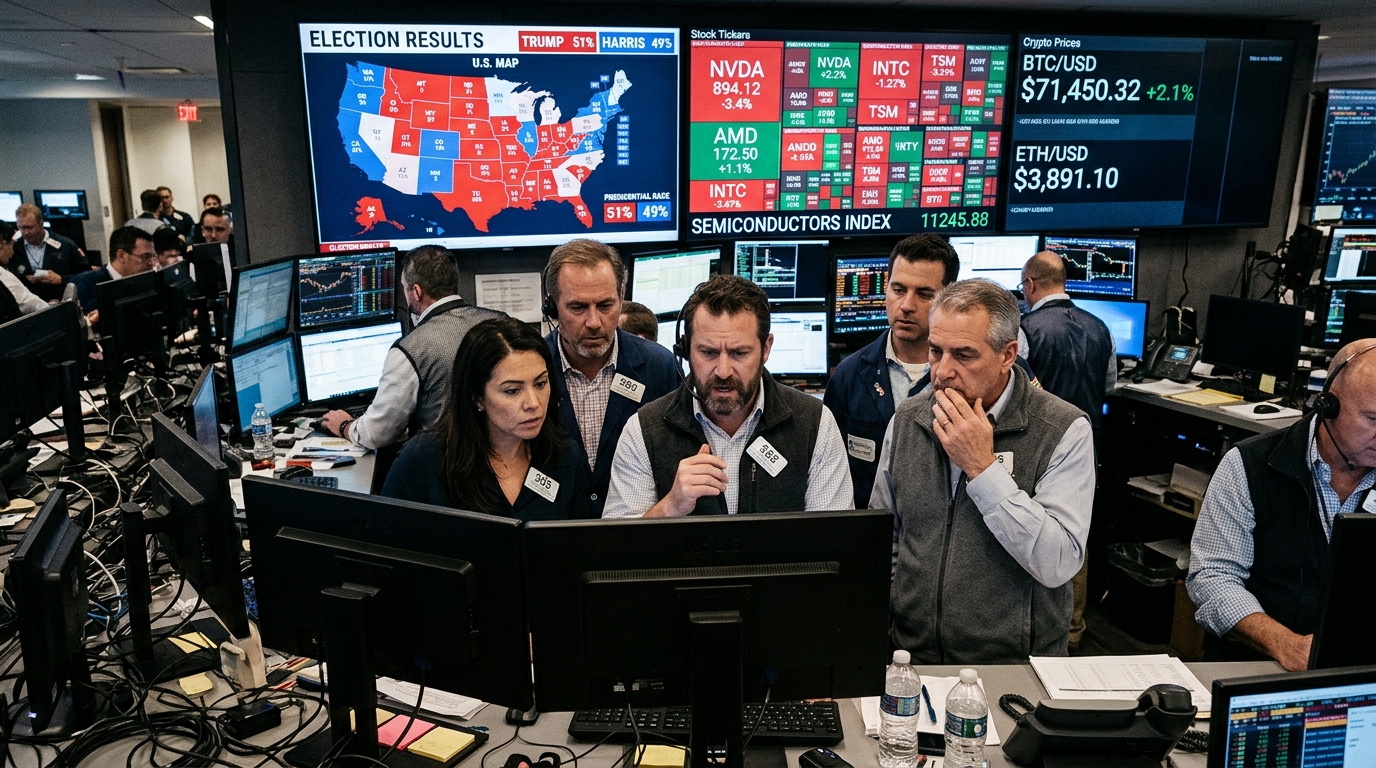
Investors spent Thursday recalibrating after a dramatic U.S. midterm result and the sharp market reaction that followed. The broad theme across asset classes was clear: markets were trying to price what a stronger Democratic position in Washington could mean for fiscal policy, regulation and the outlook for key sectors ranging from semiconductors to digital assets.
That cross-asset repricing is notable because it was reflected in several separate reports rather than a single headline. CNBC focused on the drivers behind Wednesday’s sharp rally and the political implications of the election result, while MarketWatch highlighted weakness in semiconductor shares tied to changing expectations for data-center and AI spending optimism after the vote. In crypto, Cointelegraph reported that Trump-linked tokens were among the biggest losers after Democrats swept, showing how quickly political sentiment fed into speculative corners of the market.
Stocks digest the political reset
According to CNBC reports, Wall Street’s immediate response to the election was powerful enough to spark debate over what was really behind the rally and whether investors were moving too quickly. CNBC also reported that Jim Cramer cautioned investors may be reading too much into the post-election surge, underscoring how uncertain the market’s interpretation remains.
The key issue is not simply who won seats, but how investors believe policy bargaining power changes from here. CNBC’s political coverage pointed to Democrats flipping dozens of Republican-held seats, while analysis pieces from the same outlet suggested markets may become sensitive to any attempt to extract concessions from former President Donald Trump or to pursue more aggressive oversight.
That matters for equities because the market has to weigh two opposing possibilities at once: a check on some policy uncertainty on one hand, and the prospect of tougher regulatory scrutiny and a less business-friendly tone in some industries on the other.
Chip shares lose momentum
One of the clearest sector reactions appeared in semiconductors. MarketWatch reported that Micron and other chip stocks slipped as election results struck at the core of data-center optimism. Separately, MarketWatch said Qualcomm shares fell as “twin forces” pressured sales, adding to signs that investors were already on alert for weakness in parts of the chip complex.
The election angle is important because semiconductors have been one of the market’s central AI trades. If investors start to question the pace of spending, the durability of policy support, or the strength of enterprise demand, then richly valued chip names can become vulnerable quickly. CNBC’s separate reporting on the chip talent war and rising Chinese rivals added a broader strategic backdrop: the sector is already dealing with geopolitical competition, intellectual-property concerns and supply-chain pressure.
In other words, the post-election move was not just a generic risk-on or risk-off reaction. It exposed where expectations had become concentrated, especially in AI-linked and data-center-related names.
Crypto shows a sharper political edge
The digital-asset market also reflected the election outcome, though in a more targeted way. Cointelegraph reported that Trump-linked tokens led crypto losses after the Democratic sweep, while another Cointelegraph report said crypto political action committees are already looking toward a “new map” for 2028 after Democrats took Congress.
That combination suggests traders are not treating politics as background noise. Instead, they are repricing assets directly exposed to political branding and trying to gauge how the new congressional landscape could affect crypto legislation, enforcement and lobbying strategy.
There were also separate industry-specific crypto headlines that reinforced ongoing operational risks. Cointelegraph reported that Binance and Polymarket were seeking a Polygon hard fork to recover stolen crypto, and that India warned of AI-powered hackers targeting crypto exchanges at “machine speed.” Those stories are not directly election-driven, but they show that even as politics dominates sentiment, market structure and security remain central risks for the sector.
Why this matters beyond one trading day
The broader takeaway is that investors are moving from headline reaction to second-order thinking. The first move was a rally in some risk assets; the next move has been more selective, with pressure showing up in chips and politically themed crypto trades.
According to CNBC, MarketWatch and Cointelegraph reports, the election result is already influencing how investors view regulation, bargaining power in Washington and sector leadership across markets. That makes this more than a one-session story. It is an early test of whether political outcomes will broaden or narrow the market’s winners going into year-end.
Neutral outlook: The next phase will likely depend on whether investors get clearer signals on policy, regulation and earnings resilience. For now, the market reaction appears broad enough to matter, but uneven enough to warrant caution when interpreting a single day’s move.
MarketPro reports are AI-assisted analyses of publicly reported market news. Not investment advice.