Tech selloff deepens as AI spending fears hit Wall Street
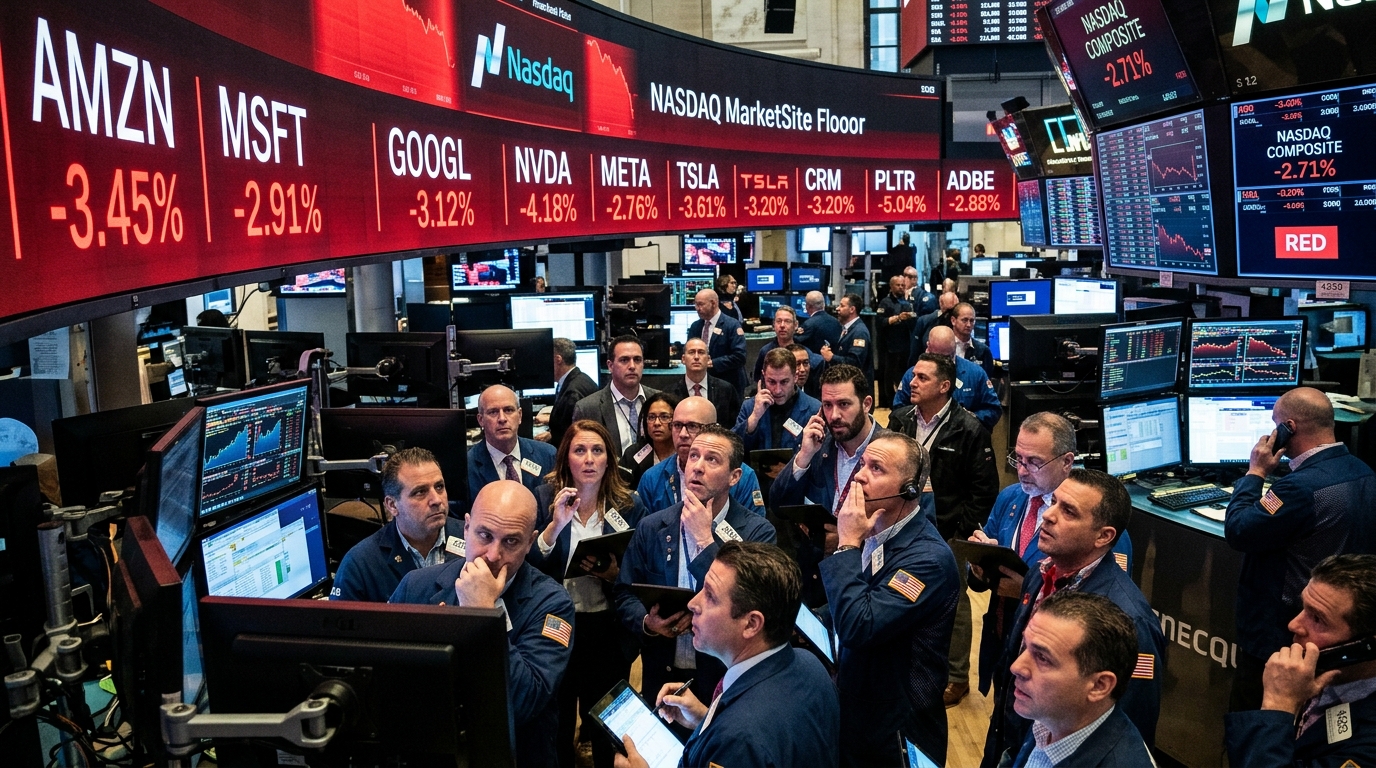
The market’s retreat in technology shares appears to be gathering pace, with several outlets pointing to the same core concern: investors are becoming less willing to reward growth at any cost, especially when that growth requires large and sustained spending on AI infrastructure and cloud capacity.
MarketWatch reported that the selloff in tech stocks is “shifting into overdrive,” while another MarketWatch headline asked whether the tech bubble has burst, comparing the Nasdaq’s rough stretch with 2000. Investing.com added that Wall Street closed sharply lower as AI cash-burn fears sparked a broad selloff. Taken together, those reports suggest this is no longer just a single-company reaction but a wider repricing across parts of the growth complex.
Why spending is back at the center
The market’s focus has shifted from who can grow fastest to who can finance that growth efficiently. That was reinforced by CNBC, which reported that S&P revised Meta’s outlook downward because of cash-flow and capital-expenditure concerns. The headline matters beyond Meta alone: if rating agencies are emphasizing capex and cash generation, equity investors are likely to do the same.
AI has helped support valuations for much of the technology sector, but the commercial payoff from that spending remains uneven. Building and operating AI models requires chips, data centers, power, networking, and software integration. In a lower-rate environment, investors may be more tolerant of that spending curve. In a market still grappling with elevated financing costs and stricter valuation discipline, the same spending can become a source of concern rather than enthusiasm.
Winners and losers are becoming more distinct
Even as the sector weakens, investors are clearly differentiating among technology names. MarketWatch reported that Microsoft is “winning the cloud wars” and becoming Wall Street’s “new golden child.” That framing implies the market is rewarding companies seen as converting AI and cloud scale into durable profitability, rather than simply into larger spending plans.
This matters because broad sector selloffs often conceal important internal rotation. Investors may still want exposure to digital infrastructure and enterprise technology, but they appear to be demanding evidence of pricing power, execution and cash flow. In that environment, established platform companies can hold up better than firms still trying to prove returns on aggressive investment programs.
The contrast also helps explain why earnings-related headlines elsewhere in the chip and platform ecosystem have had an outsized market impact. Although MarketPro is not revisiting recently covered Intel moves, the broader takeaway from today’s headlines is that semiconductor and AI-related read-throughs are affecting sentiment far beyond one stock. The market is using company updates to judge the durability of spending cycles across hardware and software.
What this means for the broader market
Technology has been central to index performance, particularly in U.S. equities. When weakness spreads across large-cap growth stocks, the effects can extend well beyond the sector itself. A deepening tech pullback can weigh on sentiment, pressure index-heavy portfolios, and tighten financial conditions if investors become less willing to support expensive growth stories.
It also intersects with macro policy. The more investors focus on cash burn and funding needs, the more sensitive the sector becomes to rate expectations. That is why today’s discussion of Fed communication, highlighted by MarketWatch in its report on transparency debates around the central bank, remains relevant. If rates stay high or policy guidance remains uncertain, long-duration growth assets can remain vulnerable.
Key themes from today’s coverage
- Valuation pressure: Investors are questioning whether recent tech pricing still matches near-term earnings and cash-flow realities.
- Capex scrutiny: Meta’s revised outlook, according to CNBC, underscores concern over heavy spending needs.
- Selective leadership: According to MarketWatch, Microsoft is standing out as a relative winner in cloud and AI.
- Index sensitivity: Because big tech carries large index weightings, sector weakness can shape the broader market.
The immediate issue is not whether technology stops growing, but whether investors still want to pay premium multiples while spending commitments rise and returns remain under debate. That is a different market regime from the one that rewarded almost any company with a strong AI narrative.
Neutral outlook: Near-term direction will likely depend on whether upcoming corporate updates reassure investors on margins and cash flow, or reinforce the idea that AI leadership comes with a higher and longer spending burden than markets had priced in.
MarketPro reports are AI-assisted analyses of publicly reported market news. Not investment advice.