AI Anxiety Meets a Packed Week for Stocks and Jobs
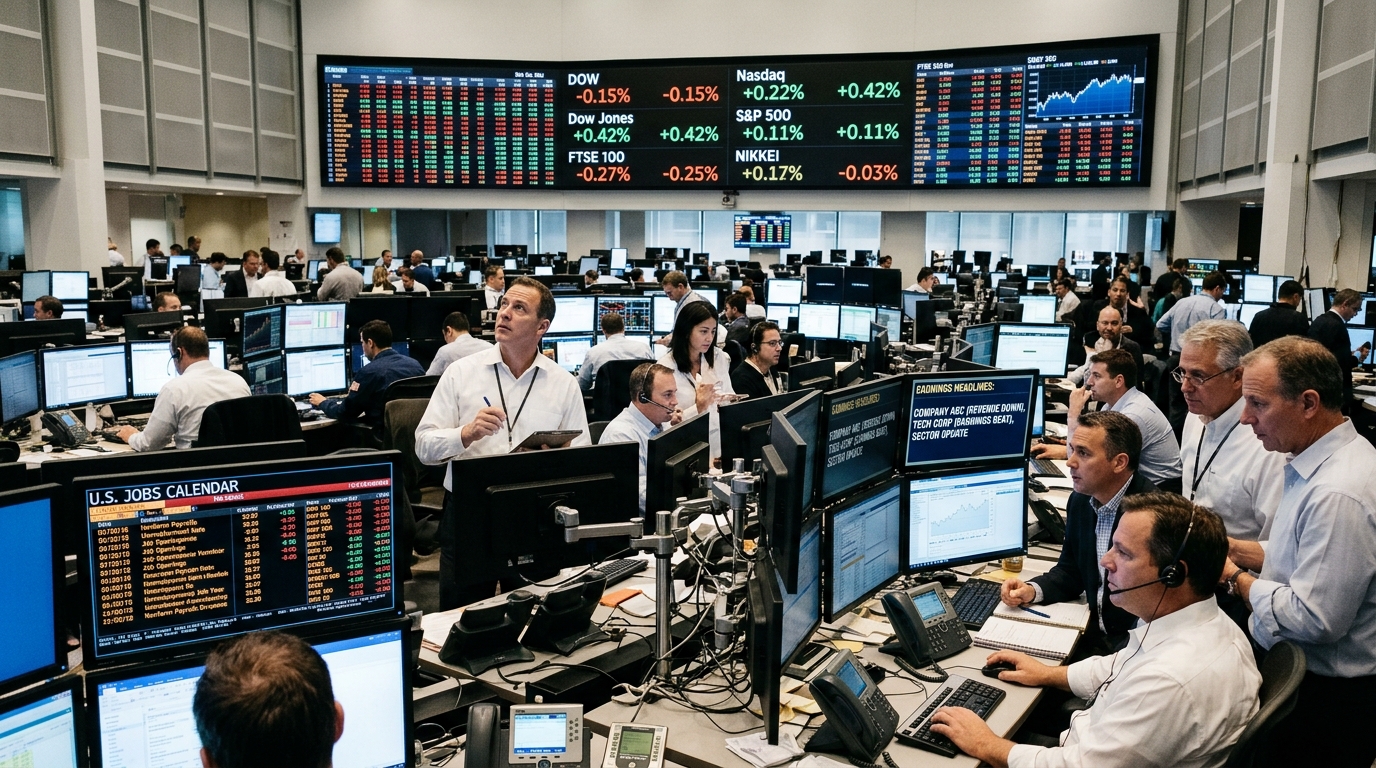
Investors are heading into a crowded week for markets with three themes colliding at once: earnings, labor-market data and election risk. According to an Investing.com report, traders are bracing for a schedule that includes U.S. midterm developments, corporate results and jobs figures, all while the market remains sensitive to whether artificial-intelligence enthusiasm can keep supporting equity valuations.
That concern lines up with a separate MarketWatch headline pointing to what it called the biggest threat to the AI-powered bull market. While the available headlines do not provide full detail on that risk, the overlap is important: multiple outlets are highlighting that the market’s AI narrative is no longer standing alone. It is increasingly being tested by macro data and by whether company earnings can justify strong positioning in growth shares.
Why this week matters beyond headline noise
For global investors, this is not only about whether major indexes rise or fall over a few sessions. It is about whether the leadership structure of the market can hold up if incoming data challenge expectations for growth, rates or corporate spending. A market heavily influenced by AI optimism tends to be especially responsive to signs that profit expansion is broadening — or failing to broaden.
CNBC added another layer to that debate with a report on how companies that promised AI gains are now showing where the payoff appeared in earnings. That matters because investors have spent much of the past year rewarding companies that linked AI investment to higher productivity, stronger advertising demand, better customer targeting or lower operating costs. If those links appear more concrete in earnings reports, sentiment can stay resilient. If not, the market may become less willing to pay premium valuations.
CNBC also highlighted a split within big tech, reporting on why AI is helping Meta’s ad business while hurting Google search. That divergence reinforces a broader message for the market: AI may be a powerful earnings driver, but not in a uniform way. Some business models appear to be gaining immediate benefits, while others face disruption or monetization pressure. For investors and economists alike, that makes index-level strength harder to interpret.
Jobs data could reset the macro conversation
The labor market remains one of the most important macro signals because it shapes expectations around consumer spending, business confidence and the policy backdrop. A strong jobs reading can support the view that the economy remains durable, but it can also complicate assumptions about the path for interest rates if wage pressure stays firm. A softer report may calm some rate concerns, yet it could also renew questions about the depth of future earnings growth.
That is why the combination cited by Investing.com matters. Earnings can move single stocks and sectors, but labor-market data can reprice the broader market, including bonds, the dollar and rate-sensitive equity groups. In an environment where AI-themed leadership has done much of the heavy lifting, a shift in the macro backdrop could spill quickly across asset classes.
Politics adds another variable
Election-related uncertainty is also back in focus. While many political stories do not always translate directly into immediate trading moves, midterm developments can affect expectations for fiscal policy, regulation and sector-specific outcomes. Those issues are especially relevant for industries tied to infrastructure, healthcare, taxation and government spending.
The key point is not that election headlines automatically override fundamentals. Rather, they arrive at a moment when markets are already being asked to absorb earnings evidence and labor-market signals. That can amplify volatility, particularly when positioning is concentrated in a handful of high-profile themes.
What markets may be watching most closely
- Earnings quality: whether companies show measurable AI-related revenue or efficiency gains.
- Labor resilience: whether jobs data support continued economic strength without reviving rate fears.
- Market breadth: whether gains remain concentrated in AI-linked names or spread more widely.
- Policy sensitivity: whether election developments shift assumptions for spending, taxes or regulation.
Taken together, the current setup suggests investors are moving from a narrative-driven market toward a proof-driven one. Reports from Investing.com, MarketWatch and CNBC all point to the same broad conclusion: confidence in the AI trade is now being tested against hard data from companies and the wider economy.
Neutral outlook: The coming sessions may tell investors less about whether AI remains important and more about whether it can continue to support markets when jobs data, earnings and politics all compete for attention at the same time.
MarketPro reports are AI-assisted analyses of publicly reported market news. Not investment advice.