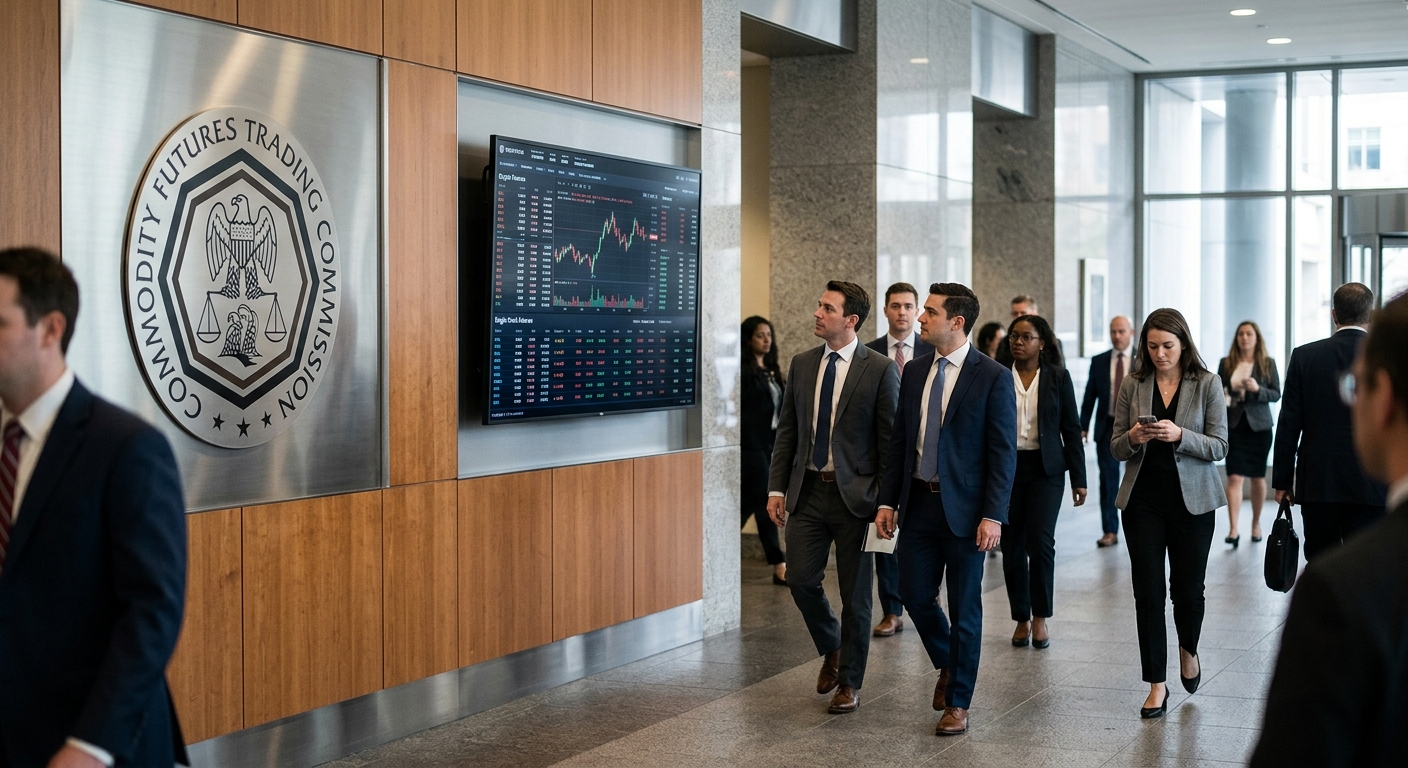
Crypto Market Structure Advances With New US Filings

Crypto market structure stayed in focus today as U.S. regulatory and product-development headlines pointed to continued pressure for broader derivatives access. According to Cointelegraph, the Commodity Futures Trading Commission submitted a crypto market regulation plan for White House review. In separate reports, Cointelegraph said Coinbase filed to bring single-stock perpetual futures to the U.S. market, and Kalshi also moved ahead with a filing tied to U.S. stock perpetual futures.
While each headline addresses a different part of the market, together they signal the same underlying trend: digital-asset firms and trading venues are still trying to define what a next-generation U.S. derivatives framework could look like.
Why the CFTC plan matters
The reported CFTC submission is important because it suggests crypto oversight is still being shaped at the federal level rather than left entirely to piecemeal enforcement or isolated agency actions. A market-regulation plan does not automatically mean new rules are imminent, but it does mean the structure of the debate is becoming more formalized.
For investors and market participants, clearer structure matters because it can influence product launches, institutional participation and risk controls. Regulatory uncertainty has long been one of the defining constraints on U.S. crypto market development. Any sign that agencies are putting forward a more organized framework tends to attract close attention.
Perpetual futures push into new territory
The Coinbase and Kalshi filings are notable because perpetual futures have historically been associated more closely with offshore crypto venues than with the heavily scrutinized U.S. market. According to Cointelegraph, both companies are pursuing products connected to U.S. stock perps, extending the perpetual-futures concept beyond its better-known crypto use.
If successful, such products could test how far U.S. markets are willing to adapt structures that have been popular elsewhere. Perpetual contracts can offer continuous exposure without traditional expiry dates, but they also raise questions around funding mechanisms, pricing integrity, leverage and investor protections.
The headlines do not indicate approval or launch certainty. What they do show is that firms continue to push product innovation despite a still-developing regulatory backdrop.
Related signals across the sector
Other crypto headlines added to the sense of momentum around market plumbing rather than token narratives. Cointelegraph also reported that REX launched a 2x leveraged ETF tied to bitcoin treasury firm Strive, and that crypto stocks rebounded after a CLARITY Act selloff. Those stories suggest that financial engineering, listed wrappers and policy-sensitive trading remain deeply linked.
At the same time, not every development is expansionary. Cointelegraph reported that VanEck criticized Metaplanet over executive dilution, underscoring that governance concerns remain relevant even during periods of product innovation.
Why this story fits the current market
Among today’s headlines, crypto stands out as one of the clearer areas where market structure, regulation and investor interest intersect directly. It also aligns with sustained reader demand for digital-asset coverage. But the more durable angle here is not price speculation; it is institutional design.
When exchanges, prediction-market firms, ETF issuers and regulators are all active at once, the market is being shaped at the infrastructure level. Those changes often have longer-lasting effects than any single day’s move in bitcoin or crypto-related equities.
What to watch next
- Regulatory response: whether the White House review of the CFTC plan leads to more visible policy coordination.
- Product approval path: whether filings for perpetual-style U.S. instruments gain traction with regulators.
- Institutional adoption: whether new structures attract established trading firms and broader market participation.
- Risk controls: how firms address leverage, pricing and consumer-protection concerns.
According to Cointelegraph, today’s developments do not resolve those questions, but they do show the pace of experimentation remains high.
A neutral outlook: the U.S. crypto market appears to be moving deeper into a regulatory-and-derivatives phase, where the key issue is less token hype and more the shape of the trading system itself.
MarketPro reports are AI-assisted analyses of publicly reported market news. Not investment advice.