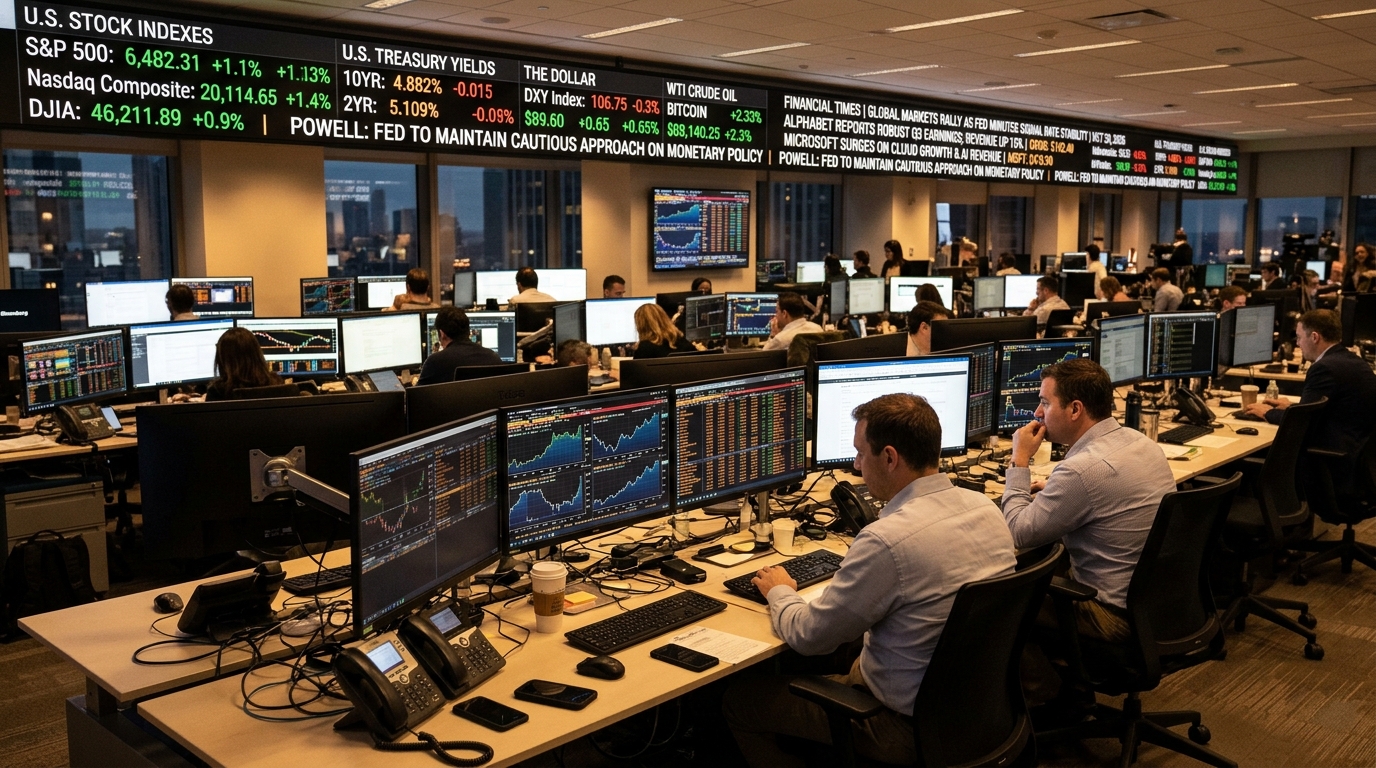
Global Markets Daily Brief — October 28, 2026
Global markets entered the session with several cross-asset themes competing for attention: AI-driven equity leadership, steady foreign-exchange positioning ahead of the Federal Reserve, renewed oil supply concerns, and fresh evidence that consumers and inflation remain central to the rates outlook.
According to Investing.com, stocks were getting an AI-related lift while the dollar held broadly steady before the Fed decision. That points to a market still willing to support technology-linked names even as policy risk caps conviction elsewhere. The tone was echoed in semiconductor-related headlines from CNBC, which reported that SK Hynix shares surged more than 8% after a profit beat and a plan to return $25 billion to investors. Separately, MarketWatch said retail traders were buying the dip on chip stocks, underscoring that the AI trade remains a major driver of risk appetite.
At the same time, caution remains visible beneath the surface. MarketWatch reported that a prominent Silicon Valley AI backer highlighted reasons to worry about an AI bubble, while another MarketWatch report said the rest of the market is beginning to leave Big Tech behind after its historic comeback. Taken together, those headlines suggest equity investors are still rewarding AI exposure, but are also becoming more selective about valuations and breadth.
Consumer resilience and signs of strain stay central
On the macro side, CNBC reported that early third-quarter earnings show a “resilient” U.S. consumer, but with signs of strain. That mix matters for markets because it does not fit neatly into either a clean soft-landing narrative or an abrupt slowdown call. Consumer resilience can support corporate revenue and labor-market stability, while signs of strain keep the door open to weaker discretionary demand and more defensive positioning later in the quarter.
Energy costs are another pressure point. MarketWatch reported that U.S. consumers are facing the most expensive year for gas prices ever, a theme that intersects directly with inflation expectations and household spending power. When paired with the mixed consumer read from CNBC, it reinforces a market backdrop in which spending is holding up, but not without pressure from essentials.
Forex focus: dollar steady, Australia inflation firms
In foreign exchange, the near-term headline was stability rather than breakout movement. Investing.com said the dollar was holding steady ahead of the Fed, a typical pattern before a major policy event when investors avoid large directional bets without fresh guidance from central bankers.
Outside the U.S., inflation data in Australia offered one of the clearer currency-related signals of the day. Investing.com reported that third-quarter inflation quickened, bolstering the case for a Reserve Bank of Australia rate hike. Even without broader market pricing detail in the headline, the implication is straightforward: firmer inflation can support expectations for tighter policy, making the Australian dollar one of the currencies to watch in the next phase of rate-sensitive trading.
Oil rises as supply concerns return
In commodities, Investing.com reported that oil prices rose after an attack on a Saudi Arabian refinery reignited supply concerns. That marks a notable shift in tone from the recent easing in crude prices and puts geopolitical supply risk back onto the market’s radar. Energy headlines also remain politically relevant in the U.S. after CNBC reported that the Trump administration may let more Russian diesel onto the market, according to comments from the energy secretary. While these are distinct developments, both point to the same underlying issue: fuel supply and pricing remain highly sensitive to policy and geopolitical shocks.
Crypto and digital money stay active, but uneven
Crypto-related signals were mixed. MarketWatch reported that Robinhood got burned by the crypto market even as retail traders bought chip-stock weakness, suggesting that speculative interest is not lifting all risk assets equally. Meanwhile, Investing.com reported that nearly 90% of businesses are turning to tokenised money, citing a DBS survey. That headline indicates continuing institutional interest in digital-money infrastructure even when retail-facing crypto trading trends are uneven.
The broader takeaway is that digital-asset market activity and tokenisation adoption are not always moving together. One reflects trading conditions; the other reflects longer-term payments and treasury experimentation.
What markets are watching next
Across asset classes, the immediate picture is one of balance rather than resolution: AI enthusiasm is supporting equities, oil is firming on supply concerns, the dollar is waiting on the Fed, and inflation and consumer spending remain the key macro bridge between all of them. A neutral near-term outlook is that investors will look for confirmation from central-bank signals and additional earnings data before pushing any of these themes much further.
MarketPro reports are AI-assisted analyses of publicly reported market news. Not investment advice.