Greenland security push puts Arctic strategy in focus
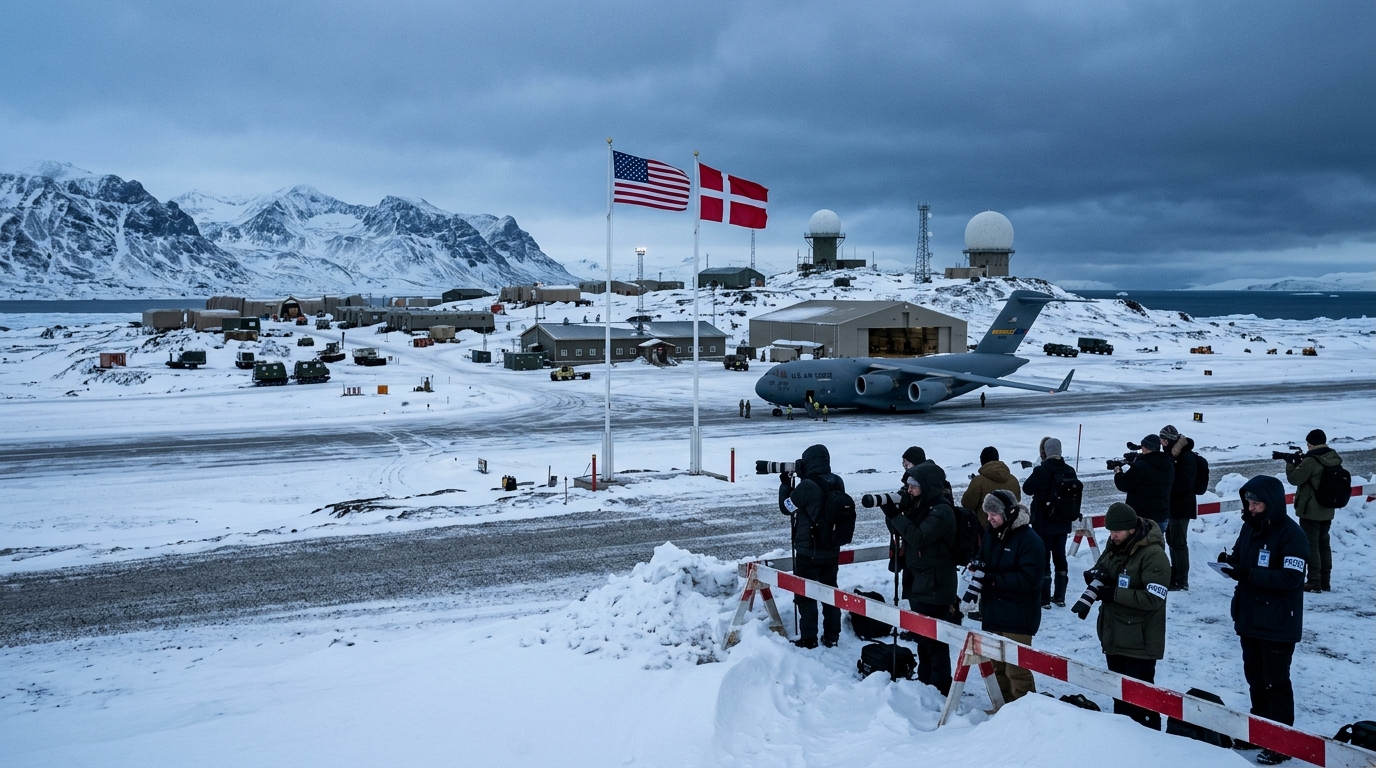
U.S. policy toward Greenland moved back into market focus after President Donald Trump said the United States would build a “large Military presence” there as part of a security deal involving Greenland and Denmark, according to CNBC reports. While the headline is primarily geopolitical, it also matters for investors tracking Arctic logistics, defense spending and North Atlantic trade routes.
The immediate significance is strategic rather than financial. Greenland sits at the center of a widening contest over Arctic access, surveillance coverage and control of sea lanes that could become more economically relevant as climate change alters shipping conditions. A larger U.S. footprint there would likely be read by markets as part of a broader Western push to secure infrastructure and military positioning across the High North.
Why Greenland matters beyond defense
Greenland’s location gives it outsized importance in missile warning, maritime monitoring and transatlantic defense planning. Any expansion of U.S. facilities could affect procurement, construction, transport and support services tied to Arctic operations. It could also increase attention on ports, airfields, satellite links and cold-weather supply chains.
For markets, that does not translate into an immediate tradeable number from the headline alone. But it does reinforce a pattern: geopolitics is increasingly shaping spending priorities in areas once considered too remote to matter economically. Defense contractors, logistics operators and infrastructure suppliers often watch these policy shifts closely because they can redirect public spending over multi-year periods.
Denmark and alliance implications
Trump framed the move as part of a security deal with Greenland and Denmark, according to CNBC. That wording matters because Greenland is an autonomous territory within the Kingdom of Denmark, making any expanded U.S. role diplomatically sensitive. A cooperative arrangement would signal continuity within the Western alliance rather than a unilateral move.
That distinction may matter to European markets. If the proposal evolves through allied coordination, it is more likely to be viewed as a conventional NATO-adjacent security development. If tensions emerge over sovereignty or cost-sharing, the market read-through could become more complicated, especially for investors already watching European defense budgets and Arctic policy.
Arctic routes and resource competition remain in the background
The strategic logic also connects with longer-term concerns over Arctic shipping lanes, seabed access and military deterrence. CNBC separately reported that a new arms race is unfolding on the ocean floor, underscoring how maritime competition is expanding below the surface as well as across traditional sea lanes. Together, the headlines suggest policymakers are thinking about strategic territory and undersea infrastructure in the same frame.
That matters because undersea cables, seabed mapping and offshore monitoring are increasingly linked to national security and commercial resilience. Even without new spending figures, the direction of travel is clear: governments are assigning higher strategic value to places and assets that were once niche concerns.
What markets may watch next
Investors will likely look for confirmation on several fronts before drawing stronger conclusions:
- Diplomatic follow-through: whether Denmark or Greenland publicly endorses or clarifies the proposed framework.
- Budget implications: whether U.S. defense planning documents or congressional discussions mention Arctic base expansion.
- Infrastructure details: whether any specific airfield, port, radar or logistics upgrades are identified.
- Alliance context: whether the move is linked to broader North Atlantic or NATO security planning.
At this stage, the headline is best understood as an important policy signal rather than a fully defined spending program. According to CNBC, Trump has put Greenland back at the center of U.S. strategic discussion. For global markets, the broader implication is that Arctic geography is no longer peripheral: it is becoming part of the mainstream conversation on security, infrastructure and long-horizon public investment.
Neutral outlook: The market impact will depend on whether the proposal develops into a formal allied plan with defined funding, assets and timelines.
MarketPro reports are AI-assisted analyses of publicly reported market news. Not investment advice.