Oracle fundraising plan pressures shares as AI spending rises
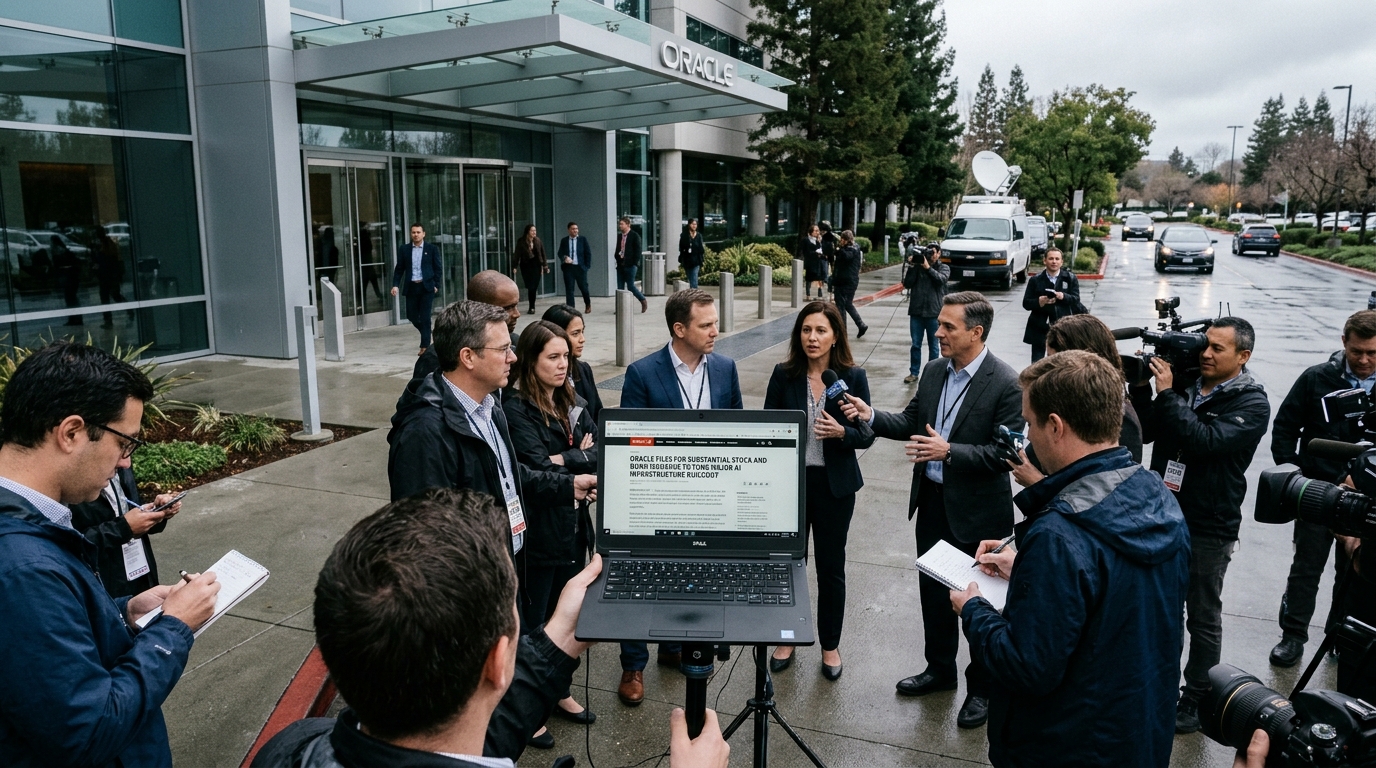
Oracle shares came under pressure after the company detailed plans to raise $20 billion through new stock and bonds to help finance its artificial-intelligence buildout, according to CNBC and MarketWatch. The dual-source confirmation makes the fundraising plan one of the clearer market-moving corporate stories of the day, especially as investors continue to scrutinize how aggressively large technology companies are spending to compete in AI infrastructure.
CNBC reported that Oracle filed to sell $20 billion in new stock and bonds to finance an AI expansion. MarketWatch separately reported that Oracle’s stock fell after the company laid out the fundraising plan. Together, those reports point to a familiar market tension in the current AI cycle: investors often reward companies for AI ambition, but can become more cautious when the scale of required capital becomes explicit.
Why the market reacted
The share-price decline reported by MarketWatch suggests that investors are focused not only on Oracle’s growth opportunity, but also on the cost of pursuing it. Raising such a large amount through a mix of equity and debt can lead to immediate questions about dilution, leverage, capital returns and the timetable for turning infrastructure investment into earnings growth.
In practical terms, a financing plan of this size signals that Oracle sees AI as a major strategic priority. It also reinforces a wider industry theme: building competitive AI capacity increasingly requires spending on data centers, networking, chips, software integration and power-intensive cloud infrastructure.
That broader context matters. Across markets, the AI trade has been driven not just by software promises but by the physical and financial demands of deployment. Oracle’s filing turns that abstract trend into a concrete funding event.
AI investment is entering a more capital-intensive phase
Investors have grown accustomed to AI-related headlines boosting valuations across technology. But Oracle’s move shows the next stage of the story may be less about narrative and more about balance sheets. Companies now have to demonstrate how they will pay for large-scale capacity growth and how quickly those investments can generate durable revenue.
That is why the structure of the fundraising matters. Issuing stock can raise capital without adding all the burden to debt markets, but it can dilute existing shareholders. Issuing bonds may preserve equity ownership, but adds financing obligations. A combined approach spreads those trade-offs, though it also makes the market’s judgment more immediate.
According to CNBC, Oracle is explicitly tying the capital raise to AI buildout. That direct linkage may reassure investors that management has a defined strategic use for the proceeds. At the same time, MarketWatch’s report on the stock decline suggests the market wants more than a strategic rationale; it wants confidence in returns on invested capital.
Why this matters beyond Oracle
Oracle’s financing plan is relevant for the wider stock market because it offers a real-time test of investor tolerance for AI spending. If shareholders push back when costs become visible, other companies may face tougher questions about funding, timelines and profitability. If the market ultimately accepts the raise as necessary for long-term competitiveness, that could support similar infrastructure-heavy strategies across the sector.
- For tech stocks: the story highlights execution risk within the AI buildout theme.
- For credit markets: large bond issuance linked to AI can become a broader funding trend.
- For equity investors: capital raises may separate firms with near-term monetization from those still in heavy investment mode.
The reaction also underscores that not all AI news is automatically bullish. During earlier phases of the AI rally, markets often focused on demand potential. Now, they appear increasingly sensitive to capital discipline and financing mechanics.
A turning point in the AI market narrative
Oracle’s move may mark a shift from AI enthusiasm to AI accountability. That does not necessarily weaken the long-term case for the company’s strategy, but it does change the debate. Investors are no longer just asking who has AI exposure; they are asking who can fund expansion efficiently and translate spending into sustained commercial gains.
Because Oracle sits at the intersection of enterprise software, cloud infrastructure and corporate AI adoption, its financing choices could be watched as a signal for the broader sector. The size of the planned raise makes the company a useful case study in how markets price AI ambition when it carries a visible funding bill.
Neutral outlook: Oracle’s filing confirms that the AI race is becoming more capital-intensive. The next market test will be whether investors treat the $20 billion plan as a disciplined growth investment or as a warning that returns may take longer to materialize, according to CNBC and MarketWatch reports.
MarketPro reports are AI-assisted analyses of publicly reported market news. Not investment advice.