Global Markets Daily Brief — September 27, 2026
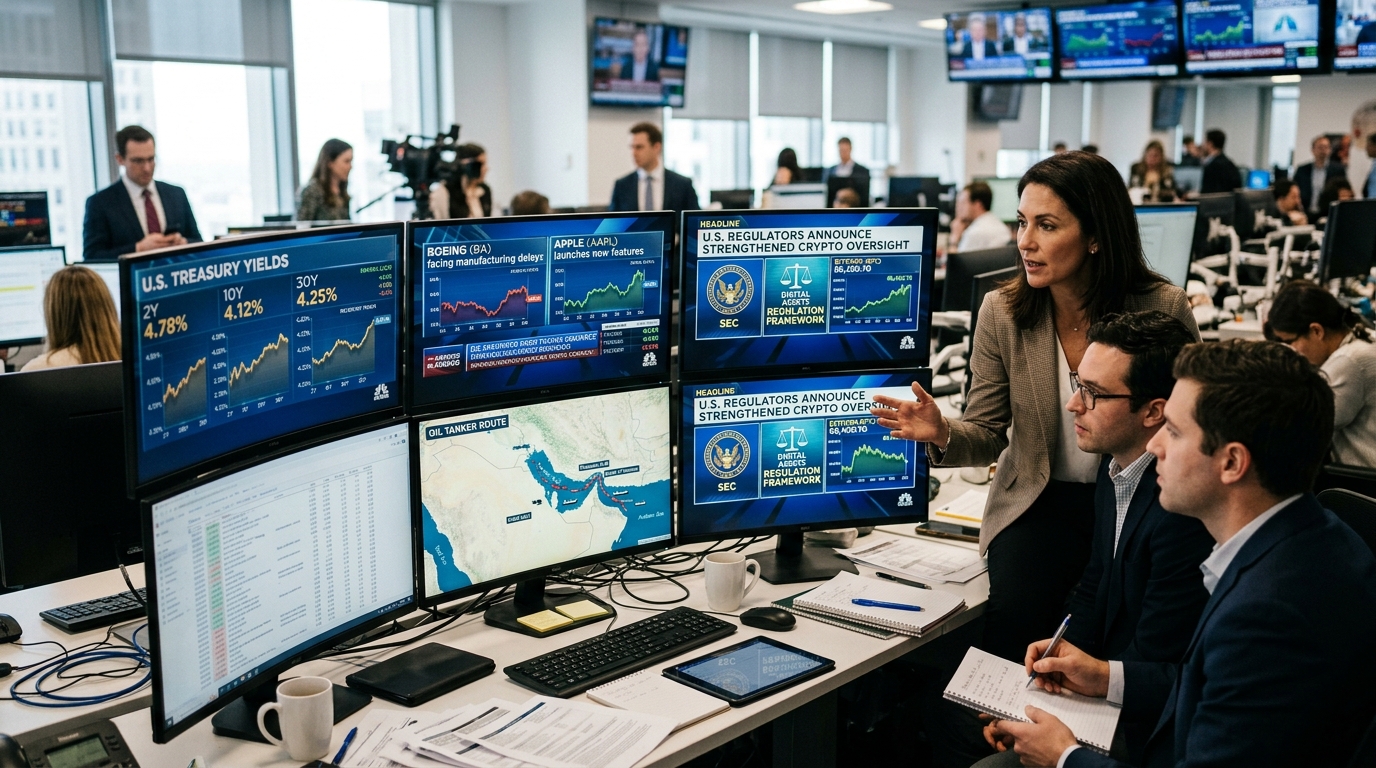
Markets entered September 27 with investors balancing higher-for-longer U.S. rates, policy changes in Washington, renewed geopolitical tension in the Middle East and a more selective regulatory backdrop for crypto.
According to CNBC and MarketWatch reports, the rise in long-dated Treasury yields remains one of the dominant cross-asset forces. CNBC highlighted that the 10-year Treasury yield is at its highest level in nearly two decades, while MarketWatch focused on how the past five years of inflation have reshaped prices from food to autos. Together, those reports reinforce a market environment where borrowing costs and inflation sensitivity are still central to asset pricing.
Rates remain the main macro driver
The clearest macro signal from today’s wire is that yields are still doing much of the market’s heavy lifting. CNBC framed the latest move in the 10-year Treasury as the result of a long build-up in inflation, policy tightening and investor repricing. A separate CNBC headline went further, noting that periods of rapidly rising rates have historically created stress somewhere in the financial system.
That does not confirm an immediate dislocation, but it does help explain why investors are watching rate-sensitive sectors, credit conditions and economically exposed equities so closely. It also keeps pressure on global funding conditions, especially where refinancing needs remain elevated.
Policy shifts add another layer
In Washington, transportation and energy policy also moved into focus. CNBC reported that President Donald Trump said he approved new fuel economy standards that roll back Biden-era rules. Investing.com separately reported that the Trump administration was set to ease those Biden-era fuel economy rules, providing a second source on the same policy direction.
For markets, the significance is less about the immediate headline effect and more about transmission into autos, energy demand assumptions, industrial planning and regulatory expectations. Investors typically read this kind of shift through the lens of sector winners and losers, but also through inflation and long-run consumption patterns.
Geopolitics and commodities stay linked
Middle East risk also remained part of the backdrop. CNBC reported that Trump rejected Iran’s conditional ceasefire proposal, citing a Wall Street Journal report, while also noting that a Saudi coalition intercepted projectiles. That combination does not by itself establish a new oil supply shock, but it keeps geopolitical risk premia relevant for energy markets.
Reader data has shown sustained interest in policy-to-commodity transmission, and today’s headlines fit that pattern: even without a confirmed disruption, markets tend to keep a close eye on shipping routes, regional security developments and any signals that could affect crude or refined-product flows.
Stocks: company-specific risk is back in focus
On the equity side, several headlines pointed to idiosyncratic operational and legal risk rather than a single broad market theme. CNBC reported that Boeing flagged a 737 Max software glitch affecting some automated approach functions, while Apple faced a $5.7 billion patent infringement verdict tied to iPhone and Apple Watch haptics.
Those are separate stories, but both underline a wider market pattern: after a long stretch dominated by macro and artificial intelligence narratives, stock-specific execution, litigation and engineering issues are again capable of moving sentiment around major names.
Elsewhere, CNBC reported that Berkshire Hathaway added to a homebuilder stake, suggesting at least some large investors are still willing to lean into selected cyclical or rate-sensitive equity exposures even as bond yields remain elevated.
Crypto stays regulation-led, not momentum-led
In digital assets, today’s more market-relevant headlines were regulatory rather than price-based. Cointelegraph reported that Kalshi lost an appeal in a case that could set up a Supreme Court path, and that SEC Commissioner Hester Peirce is set to leave her post on Oct. 2. Cointelegraph also reported that OG.com is seeking CFTC approval for single-stock perpetual futures.
That mix suggests crypto-adjacent markets are still being shaped by legal structure, market access and agency oversight more than by broad directional enthusiasm. It also aligns with recent reader preference for regulation-led crypto coverage over token-price chasing.
Asia and consumers remain under pressure points
Internationally, Investing.com reported that China consumer stocks are near decade lows as investors pile into AI. That headline stands out because it shows how narrow leadership themes can coexist with weak confidence in more traditional domestic-demand segments.
At the same time, luxury and consumer discretionary headlines were mixed elsewhere. CNBC reported record sales momentum for an Audemars Piguet-Swatch collaboration despite a broader luxury-watch slump and tariffs, while also noting record-low diamond prices amid supply glut and lab-grown competition. Those stories point to uneven consumer demand rather than a single clean trend.
Neutral outlook
The near-term market picture remains defined by high U.S. yields, policy recalibration, geopolitics and regulation-heavy crosscurrents. Unless one of those themes breaks decisively, investors are likely to keep favoring selective positioning over broad conviction.
MarketPro reports are AI-assisted analyses of publicly reported market news. Not investment advice.