Nvidia Vera Rubin Rack Launch Highlights AI Build-Out
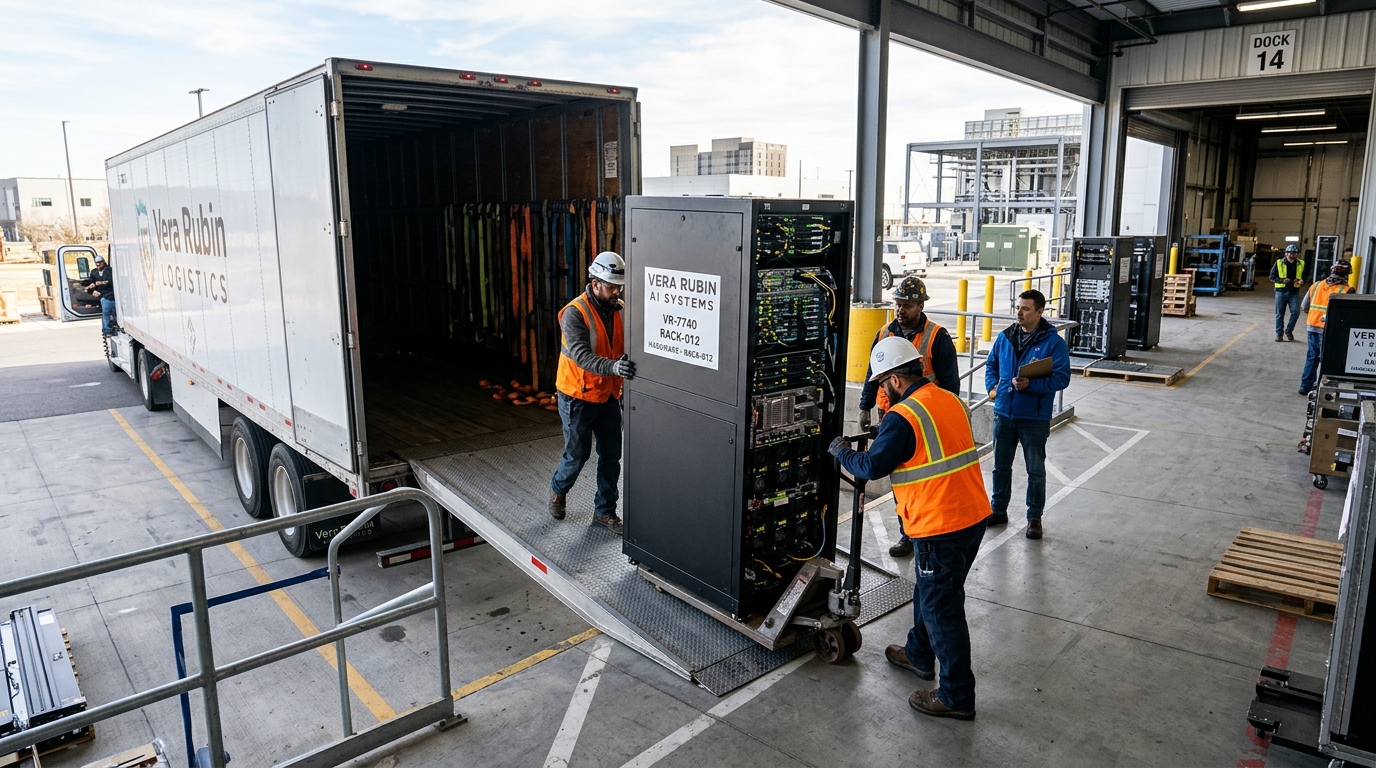
Nvidia’s latest infrastructure announcement points to a notable shift in the AI trade: the industry is moving beyond individual chips and toward faster deployment of complete computing systems. According to CNBC, Nvidia has announced plug-and-play Vera Rubin racks that can be shipped on a truck, signaling a push to make high-end AI capacity easier and quicker to install.
That may sound like a product-detail story at first glance, but it has broader market significance. For investors and industry watchers, the message is that the AI build-out is becoming more industrialized. Instead of focusing only on semiconductor performance, the market is increasingly paying attention to how quickly computing power can be packaged, delivered and turned on.
Why packaged AI systems matter
Nvidia has already become central to the global AI infrastructure boom through its chips and software ecosystem. The significance of truck-shippable, plug-and-play racks is that they address one of the market’s biggest bottlenecks: deployment speed.
Large customers want AI capacity fast, but building and integrating advanced systems can be slow and complex. A rack that arrives as a more complete unit potentially reduces installation friction for cloud providers, enterprises and data-center operators. According to CNBC, the product framing emphasizes exactly that convenience.
The launch also matches a broader market debate about where the next phase of AI spending is headed. Investors have spent much of the past year measuring demand through graphics processors and accelerator orders. Increasingly, however, the focus is broadening to include networking, power, cooling, data-center design and turnkey system architecture.
A read-through for the wider AI supply chain
This is one reason the announcement matters for stocks beyond Nvidia itself. If AI infrastructure is becoming more modular and easier to deploy, the benefits may extend across several layers of the ecosystem:
- Server manufacturers that assemble advanced computing systems.
- Networking suppliers supporting high-speed data movement inside AI clusters.
- Power and cooling providers as dense compute systems require specialized infrastructure.
- Data-center operators trying to bring new capacity online faster.
MarketWatch separately reported disruption around Nvidia CEO Jensen Huang’s speech at a Berlin conference. While that is a different headline, it reinforces the level of attention surrounding Nvidia and the AI infrastructure story globally. The more important market takeaway from the supplied wires, however, is the CNBC report on product strategy: Nvidia is framing AI hardware not only as best-in-class technology, but as something closer to a deployable industrial package.
From chip demand to installation economics
That distinction matters for equity markets. When AI enthusiasm is strongest, investors often reward chipmakers for technological leadership alone. But as the cycle matures, practical questions become more important: How fast can customers install systems? How much labor and engineering work is required? How soon can spending convert into usable compute capacity?
By emphasizing racks that can be shipped on a truck and put to work more quickly, Nvidia appears to be addressing these operational questions directly, according to CNBC. That could help sustain the company’s central role in AI capital expenditure discussions, especially if customers prioritize speed-to-deployment alongside raw performance.
It also fits with a broader market theme seen across technology and industrials: AI is no longer only a software or chip story. It is increasingly a logistics, energy and infrastructure story. Investors looking at the next leg of the build-out are paying closer attention to who can reduce friction in the physical deployment process.
Why markets care now
The timing is notable because enthusiasm around AI remains high, but so does scrutiny. Markets have become more selective about which announcements signal real demand visibility rather than concept-stage ambition. A practical infrastructure product can carry more weight than a theoretical roadmap if it indicates customers are preparing for scaled implementation.
Based on the supplied reporting, Nvidia’s announcement offers that kind of signal. It suggests the company sees an opportunity not just in selling components, but in shaping how AI factories are physically delivered.
Neutral outlook
The key issue now is whether turnkey AI infrastructure translates into faster customer adoption and broader spending across the data-center ecosystem. Markets will likely watch for follow-through from enterprise buyers, cloud operators and suppliers tied to AI deployment.
MarketPro reports are AI-assisted analyses of publicly reported market news. Not investment advice.