Volatility Spike Puts Post-Election Stock Trades Under Pressure
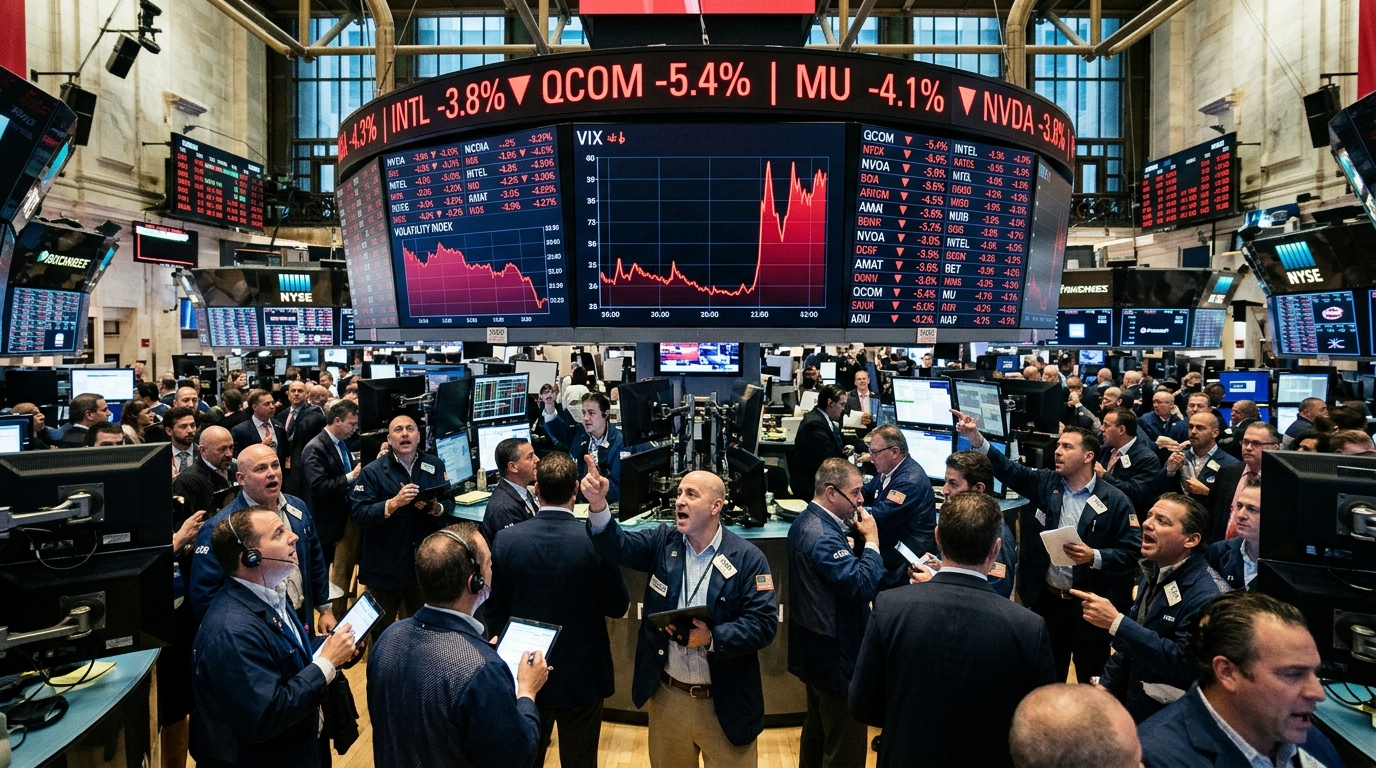
Wall Street’s post-election reset appears to be hitting some of the market’s most crowded trades first, as volatility jumps and semiconductor shares retreat. Separate reports from CNBC and MarketWatch point to the same broad message: investors are becoming less comfortable with uncertainty, especially in areas that had been key drivers of equity performance.
According to a CNBC report, Wall Street’s so-called fear gauge surged by its largest amount since April, a sign that options traders are paying more for downside protection. CNBC said some traders believe volatility should be even higher, underscoring concern that recent market pricing may not yet fully reflect the range of political and macro risks now in play.
At the same time, according to CNBC, Qualcomm shares fell 9% after earnings, helping lead a broader postelection sell-off in chip stocks. MarketWatch separately reported that Micron, Sandisk and other AI-linked shares were also falling hard, with one strategist quoted by the publication saying investors “don’t like uncertainty.” Bloomberg and Reuters are not among the supplied sources today, but the CNBC and MarketWatch headlines together support a clear cross-market read: a reassessment is underway in technology and especially semiconductors.
Why the chip retreat matters
Semiconductor stocks have been central to the market narrative for much of the year, not only because of earnings expectations but also because they have served as a direct expression of enthusiasm around artificial intelligence, data centers and high-performance computing. When that group weakens at the same time volatility rises, it can signal more than an isolated earnings reaction.
Qualcomm’s decline matters because earnings-related selling in a major chip name can ripple across the sector. Meanwhile, MarketWatch’s report on sharp declines in Micron, Sandisk and other AI-related stocks suggests investors are not simply reacting to one company-specific event. Instead, they may be questioning valuations, near-term demand assumptions, or how quickly AI-related spending translates into broad earnings support.
MarketWatch also reported that some of the year’s most successful stock-market trades are unraveling, potentially for good. That fits with the idea that investors are rotating away from trades that had become consensus positions. Once volatility rises, those positions can become more vulnerable as funds reduce risk exposure.
Election uncertainty is colliding with valuation sensitivity
The market backdrop also matters. CNBC separately reported on how the midterms could fuel a “K-shaped” AI trade, implying that not all AI beneficiaries are likely to perform equally in the new environment. In practical terms, that can mean investors becoming more selective and less willing to pay premium valuations across the board.
That shift is significant because elevated technology valuations often require a stable macro backdrop and high confidence in forward growth. A jump in the VIX or similar volatility measures can challenge both conditions at once. When investors become unsure about policy, rates, regulation or fiscal direction, they often trim positions in high-multiple stocks first.
MarketWatch’s headline asking whether this is “the big one” for the stock market adds to the sense that investors are testing whether the latest drop is a routine pullback or the beginning of a deeper repricing. The publication also framed the move as a tech-led plunge, reinforcing the idea that leadership is narrowing or shifting.
What investors appear to be watching
- Volatility pricing: CNBC’s report on the sharp surge in the fear gauge suggests hedging demand is climbing.
- Sector leadership: Semiconductor and AI names are taking pressure, according to CNBC and MarketWatch.
- Crowded trades: MarketWatch’s report on successful trades unraveling indicates broader de-risking beyond single stocks.
- Policy uncertainty: Election-related questions may be making investors less willing to hold aggressive growth positions.
More than an isolated tech wobble
What makes this move notable is the combination of signals rather than any one headline. CNBC’s volatility report suggests a broad market demand for protection. The Qualcomm decline points to company-level disappointment or caution having sector-wide consequences. MarketWatch’s coverage of weakness in Micron, Sandisk and other AI stocks indicates that the sell-off is spreading across a theme that had previously attracted substantial investor interest.
For now, the evidence from CNBC and MarketWatch supports a cautious conclusion: the market is moving from election reaction to position reassessment, and technology is at the center of that shift. Whether this becomes a wider correction will depend on how quickly volatility stabilizes and whether investors regain confidence in the earnings and spending outlook for chipmakers and AI-linked companies.
Neutral outlook: The next test for markets is whether volatility remains elevated and whether semiconductor weakness broadens beyond earnings-driven selling into a more sustained rotation across equities.
MarketPro reports are AI-assisted analyses of publicly reported market news. Not investment advice.