World Bank Lifts East Asia Outlook, Flags AI Risks
The World Bank’s decision to lift its growth outlook for East Asia and the Pacific while warning about the risks of artificial-intelligence concentration gives investors and policymakers a two-sided regional signal: near-term momentum may be improving, but the next phase of growth could become more uneven.
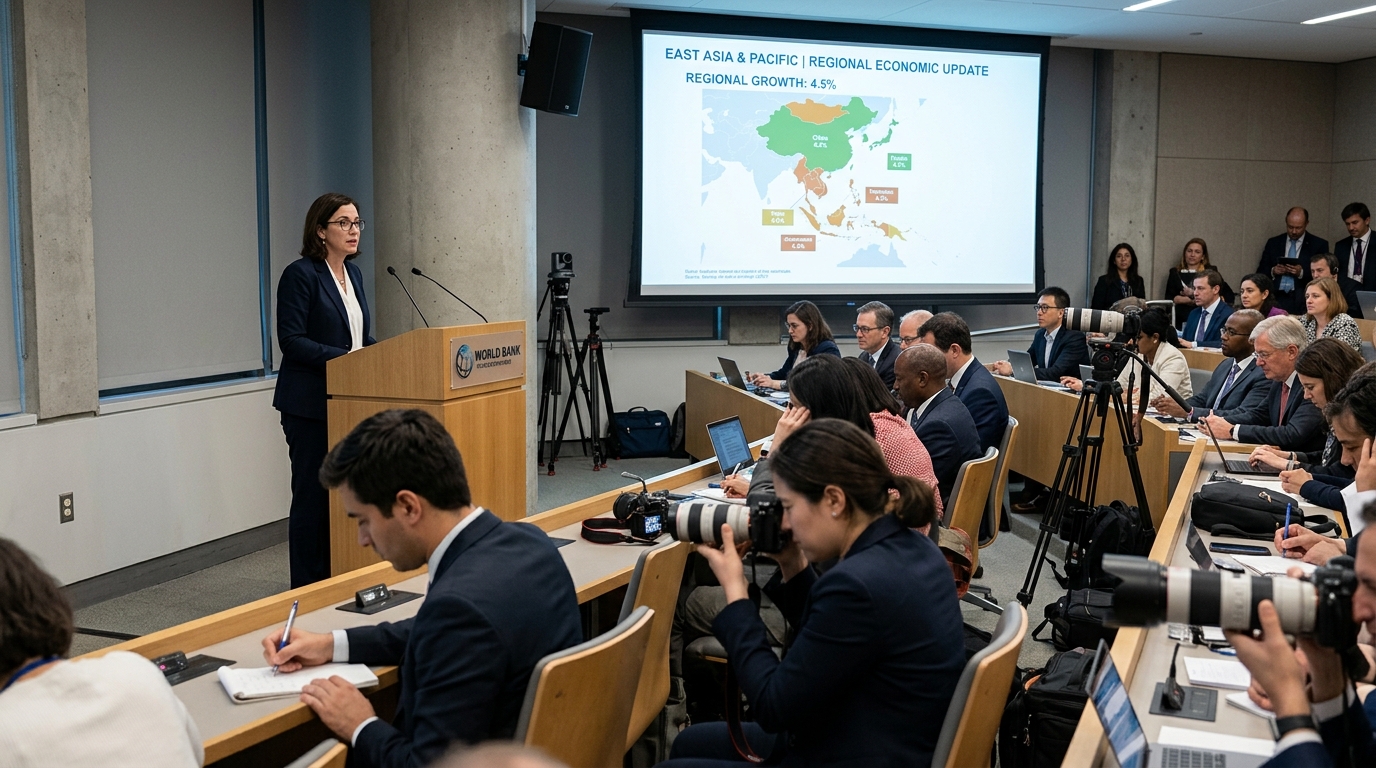
According to a CNBC report, the World Bank raised its forecast for East Asia and Pacific growth to 4.5%. At the same time, it warned that AI development and access could become concentrated in a relatively small number of firms and economies, potentially limiting how widely the gains are shared across the region.
That combination matters for markets because East Asia remains central to global manufacturing, trade flows and technology supply chains. A firmer regional growth outlook can support expectations for imports, exports and capital spending. But the World Bank’s warning suggests that stronger headline growth does not automatically mean balanced growth across countries, industries or labor markets.
Why the upgraded outlook matters
An improved World Bank forecast is notable at a time when global investors are still watching trade frictions, uneven demand and the policy path in major economies. East Asia and the Pacific includes several export-driven economies that are deeply tied to electronics, industrial production and cross-border logistics.
If growth expectations improve, that can shape views on corporate revenue exposure, commodity demand and regional currencies. It can also affect how governments in the region frame fiscal priorities, especially where public investment and industrial policy are being used to strengthen domestic manufacturing and digital infrastructure.
Still, a higher growth forecast should not be read as a blanket regional story. East Asia contains economies at very different stages of development, with varying exposure to Chinese demand, U.S. trade policy and technology controls.
AI concentration is emerging as a macro issue
The World Bank’s caution on AI concentration stands out because it moves the AI discussion beyond equity-market enthusiasm and into development policy. According to CNBC, the concern is that the benefits of AI may cluster among a limited number of large companies and richer economies with stronger computing infrastructure, deeper pools of talent and better access to capital.
For emerging Asian economies, that raises several questions:
- Productivity: Will local firms be able to adopt AI tools widely enough to improve output and competitiveness?
- Labor markets: Could automation gains arrive faster than workforce retraining?
- Capital access: Will financing increasingly favor markets already dominant in chips, cloud and software?
- Trade positioning: Can smaller economies move up the value chain, or will they remain dependent on lower-margin manufacturing?
These issues matter because AI is increasingly linked to competitiveness in both services and industry. If computing power, advanced semiconductors and foundational models remain concentrated, then the growth dividend may accrue disproportionately to a narrow set of players.
What global markets may watch next
The market significance is not just regional. East Asia’s role in the global economy means any split between stronger aggregate growth and uneven technology diffusion could influence multinational investment decisions.
Investors may pay close attention to:
- Government support for data centers, power supply and digital infrastructure
- Education and workforce policies aimed at AI adoption
- Cross-border technology restrictions and licensing rules
- Whether export-oriented economies can translate AI demand into broader domestic gains
The World Bank’s message also aligns with a broader policy debate playing out globally: whether AI will narrow productivity gaps or widen them. For East Asia, that debate is particularly important because the region includes both advanced technology hubs and middle-income manufacturing centers seeking to avoid being squeezed between rising costs and higher-tech competition.
A growth upgrade with a policy warning attached
The World Bank’s updated forecast offers a constructive near-term read on East Asia and the Pacific. But the accompanying warning means the institution is not treating AI as an automatic growth equalizer. According to CNBC, the core concern is concentration—of infrastructure, capability and economic gains.
That makes this more than a standard forecast revision. It is also a signal that future regional performance may depend less on whether AI expands, and more on how broadly economies can access and apply it.
Neutral outlook: The upgraded growth view may support confidence in East Asia’s near-term resilience, but markets are likely to keep focusing on whether AI-driven gains spread across the region or remain concentrated in a few dominant centers.
MarketPro reports are AI-assisted analyses of publicly reported market news. Not investment advice.